
All primary authors who submit an abstract will be notified of their acceptance status by April 3, 2026 and posters for printing and judging will be due April 15, 2026.
If you have not heard back from us by April 3 regarding your abstract submission, please check your spam folder or contact an organizer or your faculty sponsor/mentor.
This guide will help you create and submit a poster that shines at the conference! Here’s what you need to know about presenting your work:
Registration
Remember to register for the conference (including all co-authors/presenters who plan to attend) using the link in your acceptance letter.
Faculty Sponsors/Mentors
Please ensure that your faculty sponsor(s)/mentor(s) have reviewed and approved your poster presentation before submitting it for printing.
Poster Size and Printing
- Size: Standard poster size is 48 inches wide by 36 inches tall (4:3 ratio). This is the recommended size to avoid any scaling issues during printing.
- Submitting your poster: Upload a full-sized PDF (best for preserving formatting) or PPT/PPTX file by the deadline provided in your acceptance letter.
- PDF files: Make sure your poster is not reduced to letter size paper when converting to PDF. This can happen when printing to PDF (it’s better to convert using ‘Save As’ or ‘Export’ options to ensure the original size is maintained).
- PowerPoint files: If submitting a PPT/PPTX file, conference staff will quickly check for formatting issues and make light corrections (time allowing) before converting to PDF for printing. Please note that less common fonts may change during the conversion.
- What NOT to submit: We cannot print late submissions, multi-page slide decks, Word documents, or other non-standard formats. Wide-format posters will be printed on 48″ x 36″ poster paper, resulting in unused white space above and below your poster design.
Images and Graphics: Making your Visuals Pop
- Resolution matters! Use high-resolution images (300 pixels per inch, or ppi, is ideal). Lower resolutions (around 200 ppi) might be acceptable, but anything lower could appear blurry.
- Sizing Images: To check image size suitability, divide the image dimensions (height x width) by 300 (ppi). This gives you the recommended size of the image (in inches) for your poster.
- Vector vs. Raster formats: The ‘300 ppi’ rule applies to photos, screenshots, and most images found online. These are raster images, which are harder to enlarge beyond their original dimensions. Charts and graphs pasted from PowerPoint or Excel are vector graphics, which can be scaled to any size without losing quality.
- Example: A photo (1200px x 1800px) would look best at 4″ x 6″ size (300 ppi) on your poster. A maximum size of 6″ x 9″ (200 ppi) might still work without looking too blurry.
Need Help?
Feeling overwhelmed by formatting? Take a look at our tutorials and templates below to help you get started.
Tutorials
- What makes a great research poster? [Good and Bad Examples] – YouTube video with great tips and examples.
- Purdue Online Writing Lab: Research Posters – A comprehensive resource guide to help writers plan and compose research posters.
- How to make an academic poster in PowerPoint – YouTube video demonstrating how to design a poster in PowerPoint.
- Making a Poster Using PowerPoint (pdf) – Beginner’s tutorial for resizing and adjusting various elements in PowerPoint.
Poster Presentation Templates
#betterposter Templates
Inspired by user experience (UX) researcher Mike Morrison’s call on YouTube to improve the scientific poster format, these templates place the key finding of your project front and center, in plain language, for attendees to easily read and digest as they walk by your poster. View more #betterposter templates here.
Click thumbnails for larger preview.
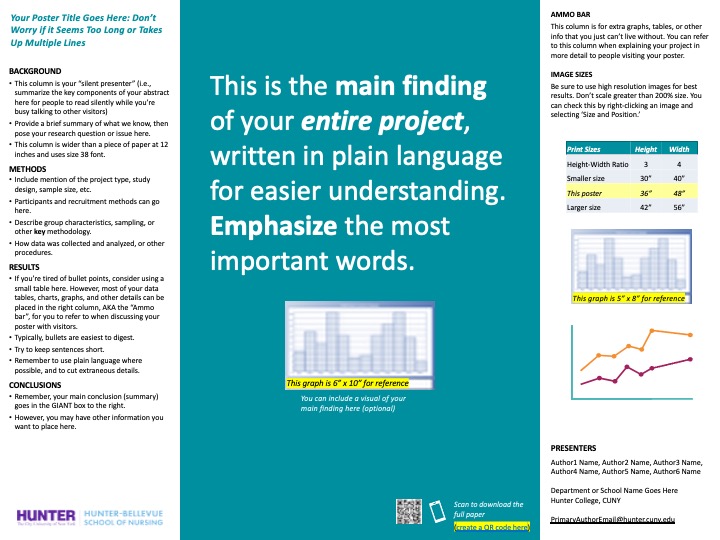
#betterposter aqua |
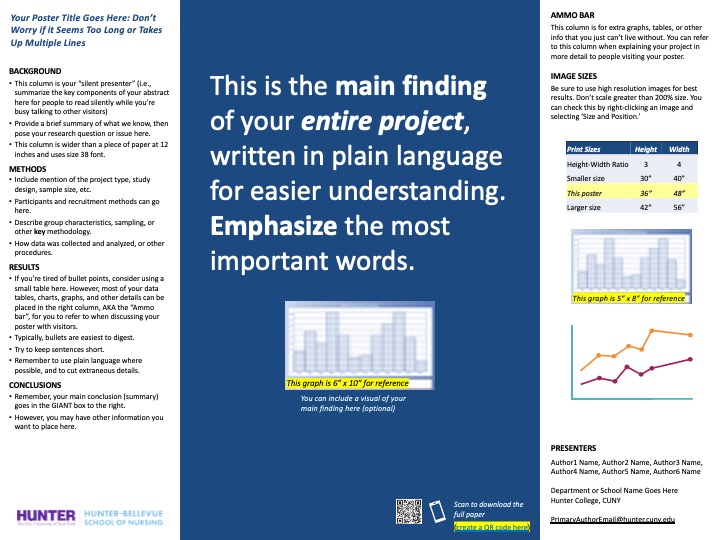
#betterposter blue |
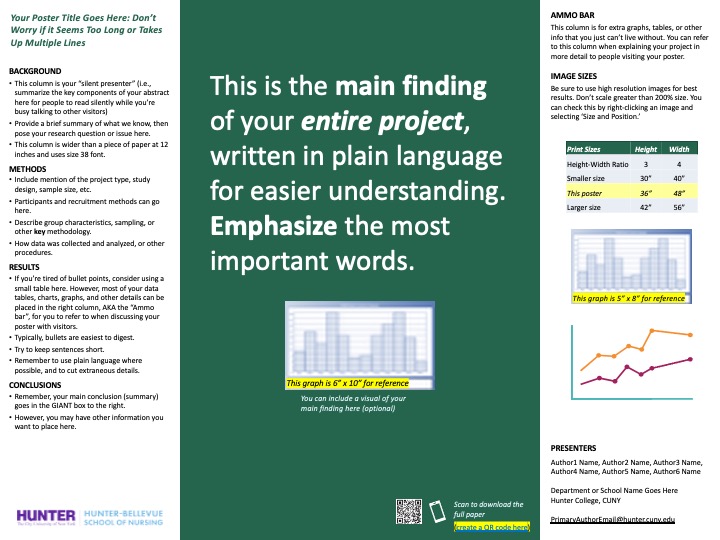
#betterposter green |
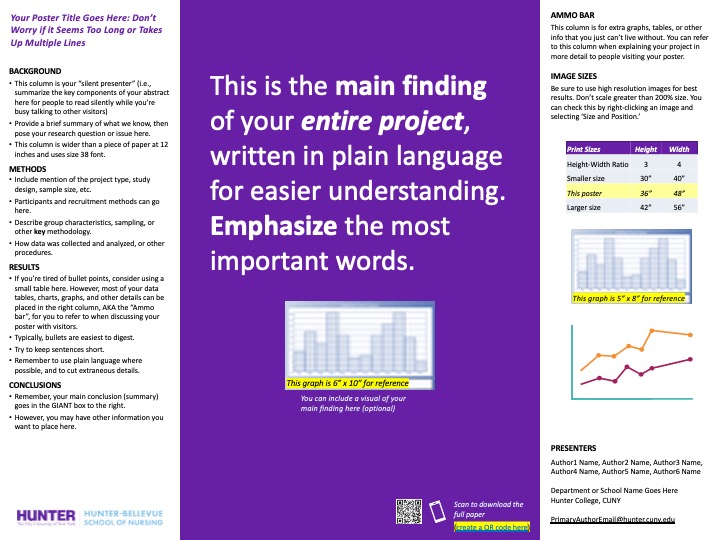
#betterposter purple |
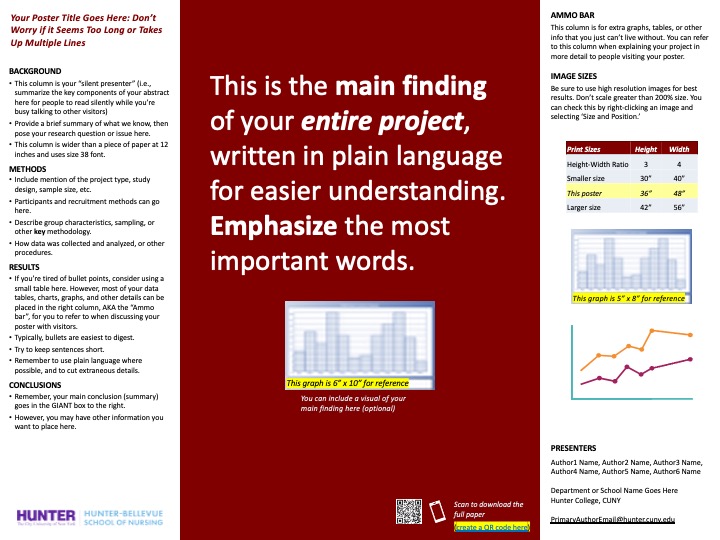
#betterposter red |
‘Classic’ Templates: Horizontal/Landscape Orientation

HBSON 3-column table |

Hunter 3-column table |

Dark purple background |

Green with gradient background |

Purple with gradient background |

Sparse White |

Sparse with blue footer |

Red with purple gradient |
‘Classic’ Templates: Vertical/Portrait Orientation

Vertical with blue footer |

Vertical purple background |

Vertical green background |
Poster Presentation Rubric
Refer to our poster presentation rubric for additional guidelines in preparing your poster.
EBP-Poster-Day_Poster-Presentation-Rubric
Examples
Please explore the poster awards page of our last virtual conference for examples.

This entry is licensed under a Creative Commons Attribution-NonCommercial-NoDerivatives 4.0 International license.

